"Clean the office" is a four-word scope of work, and it is where most commercial cleaning relationships start to go wrong. The vendor assumes the breakroom refrigerator is extra. The office manager assumes it was always included. Neither is wrong, because nothing was written down.
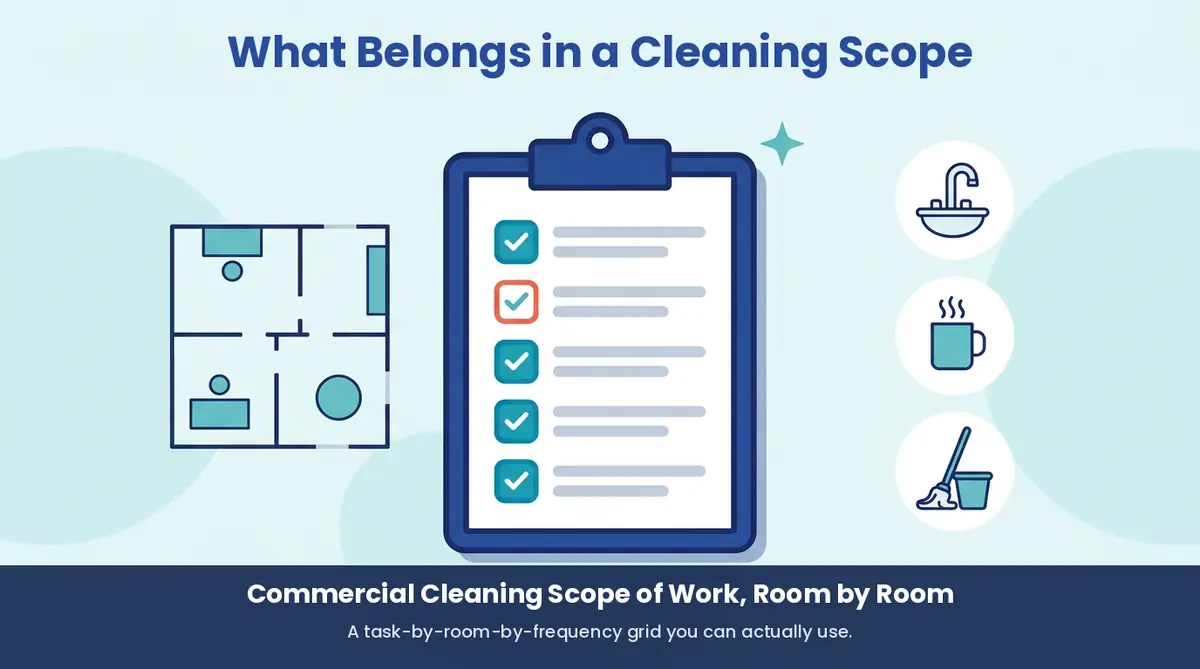
Direct answer: a good scope of work is a grid. Rooms run down the side, tasks run across, and every cell carries a frequency: every visit, weekly, monthly, quarterly, or only when you authorize it. If a task is not in the grid, it is not part of the price. If it is in the grid, both sides can check it.
Four things people call "commercial cleaning"
The phrase covers very different jobs. Naming which one you are buying is the first line of any scope.
| What it's called | What it actually is | Typical rhythm |
|---|---|---|
| Routine janitorial | Trash, restrooms, floors, and touch surfaces kept to an agreed standard | Daily to weekly |
| Periodic or specialty work | Tasks that do not need every visit: carpet extraction, floor machine work, interior glass, high dusting | Monthly, quarterly, or by authorization |
| One-time deep clean or reset | A defined, intensive set of tasks done once or on a calendar | One-time or monthly |
| Post-construction cleaning | Dust and debris removal after a build-out or repair | One-time, after the project |
Public buyers draw the same lines. The Alamo Area Council of Governments' 2026 commercial janitorial RFP sorts its tasks into daily, weekly, and periodic services, and adds quarterly items for common areas. That is one buyer's document, not a rulebook, but it shows how a careful buyer thinks about the work.
The grid: rooms by tasks by frequency
Here is a sample for a small office. It is an illustration of the format, not a template for your building and not a legal document.
| Area | Every visit | Weekly | Monthly | Quarterly |
|---|---|---|---|---|
| Entrance and lobby | Empty trash, vacuum or mop, wipe door handles and glass at touch height | Wipe baseboards at entrance | Spot-clean walls | Interior glass, full |
| Open office and desks | Empty trash and recycling, vacuum | Dust horizontal surfaces (not desk contents) | Vacuum edges and under reachable furniture | High dusting |
| Restrooms | Restock, clean and disinfect fixtures, mop | Wipe partitions and mirrors in full | Descale and deep-clean grout lines | Machine-scrub floor |
| Breakroom | Wipe counters and table, empty trash, clean sink | Wipe appliance exteriors | Clean inside microwave | Clean inside refrigerator (customer clears it first) |
| Hard floors | Sweep and mop | Detail corners and edges | Machine scrub | Strip and refinish (by authorization only) |
| Carpet | Vacuum | Spot treat | Edge and detail vacuum | Hot-water extraction |
The right column for your building depends on foot traffic, the business you run, and the budget. A dental-supply warehouse and a law office read the same grid very differently.
Square footage: gross is not cleanable
Many quotes start from square footage, and two numbers hide behind that phrase. Gross square feet includes walls, mechanical rooms, and storage you never want cleaned. Cleanable (or serviced) square feet is the floor area the crew will actually work. Write down which one the price uses, who measured it, and how a disagreement gets settled. It is a small line that prevents a large argument.
Exclusions and no-touch zones
Every scope needs a short list of what the crew will not touch. Common entries:
- Papers, files, and anything on desks that could be a business record
- Production machinery and anything with moving parts or live power
- Clinical, laboratory, or food-contact equipment
- Work at heights beyond a stated limit
Exclusions protect both sides. They keep a crew from moving the wrong thing, and they keep a buyer from assuming a task is covered when it is not.
Supplies: who buys what
Cleaning chemicals and consumables are two different line items, and they are easy to blur. The AACOG RFP states that the contractor "shall furnish all cleaning chemicals, disinfectants, liners, equipment, tools, carts, ladders," and separately asks respondents to "clearly identify in their Proposal any consumables they assume will be furnished by AACOG." The City of Cedar Park's 2026 janitorial RFP, an Austin-area buyer rather than a San Antonio one, adds a monthly inventory of consumable supplies for the contractor to complete and submit.
In plain terms: decide who buys paper towels, soap, and trash liners, and write it in the scope. If you supply them, say who keeps count.
Access: keys, codes, and hours
The scope should say how the crew gets in, when, and what happens to keys and codes. Cedar Park's RFP puts the standard clearly: the contractor must have methods to keep keys and badges from "unauthorized persons," and "Keys and badges may not be used to unlock doors or enter facilities outside of authorized cleaning hours." Whatever your building looks like, the same questions apply. Who holds keys? Who can reset an alarm code? What happens if a crew member leaves the company?
Also decide whether you want after-hours service or a day porter. AACOG's RFP includes day porter coverage "from 10:00 a.m. to 2:00 p.m., Monday through Friday," which is a separate service from nightly janitorial. If you want midday restroom checks or breakroom resets, it needs its own line.
Extra work needs a written approval
The most useful sentence in a scope may be the one about change. AACOG's RFP says that it "must authorize any special, emergency, supplemental, or out-of-scope service in writing before performance." You do not need a procurement office to borrow that idea. If the crew finds something outside the grid, such as a spill cleanup, a flooded corner, or a request from your sales team to prep a showroom, it should be approved by email before it is done and priced before it is billed.
How a finished visit gets confirmed
A scope should say how you know the work happened. Cedar Park's RFP asks that "at the conclusion of each service, the assigned on-site supervisor shall inspect the facility for completion and performance quality of the required services." That is a useful pattern for any size of building: someone other than the person who cleaned looks at the result, and anything that was not completed is written down, not hoped about.
What we are not claiming
The sample grid above is a format, not a legal template, and it is not sufficient on its own as an agreement. The AACOG and Cedar Park documents are examples of what two public buyers asked for in 2026. They do not prove what private San Antonio businesses typically require, and we are not saying you need to match a government RFP. We also are not saying a detailed scope costs more or less than a vague one. It makes the price comparable and the work checkable. Have your attorney review any agreement before you sign it.
How we handle scope at Chabod
We run recurring monthly facility resets for commercial and industrial clients, and the work starts the same way every time: a walkthrough, then a written scope for that specific property. Each property gets its own SOP, so the crew is working from the grid for your building, not a generic checklist. Visits are photo-documented, a second person checks the work against the scope, and anything we find outside it, such as a leak, damage, or a pest sign, gets reported instead of ignored.
If you are comparing us with anyone else, ask both of us the same thing: show me the grid.
Want a written scope for your building before you commit to anything? Request a walkthrough and we will put the rooms, tasks, and frequencies in writing. If you want to see how a monthly reset differs from routine upkeep, start with our facility reset guide, or see how deep cleaning differs from regular cleaning.