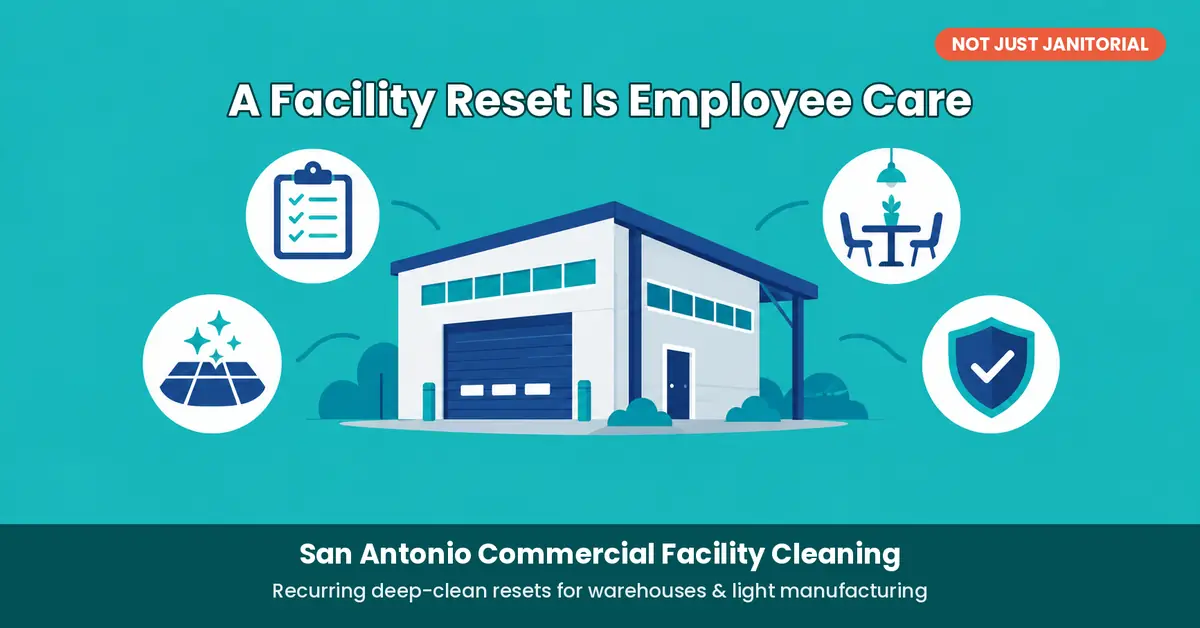
There's a difference between a facility that gets cleaned and a facility that gets reset. Daily or weekly janitorial keeps floors swept, bins emptied, and restrooms stocked. It's not built to reach the places that quietly accumulate over months — dust on overhead piping, buildup behind break room appliances, grime along baseboards nobody's touched since the last walkthrough, storage areas that have become a dumping ground for whatever didn't fit anywhere else.
That gap is where a recurring facility reset comes in. And increasingly, employers running warehouses, light manufacturing, and active work facilities in San Antonio are starting to treat that reset as something closer to employee care than a line-item cleaning expense.
The employee-experience signal — and what it actually shows
Here's a real data point worth paying attention to: in a 2024 survey of over 1,000 U.S. healthcare employees, more than 70% of people not considering leaving their job described their employee-facing spaces — break rooms, offices — as clean, safe, and well-maintained. Among people who were considering leaving, that number dropped to under 60%.
That's a real association, and it's worth being honest about what it is and isn't. It's not proof that a clean break room keeps someone from quitting. It's evidence that the condition of the spaces employees actually use — not just the areas a client or visitor sees — tracks with how people feel about staying. Facilities-management research more broadly backs this up: occupant wellbeing and workplace safety consistently rank among the top priorities facilities leaders report focusing on.
The practical takeaway isn't "clean floors guarantee retention." It's narrower and more honest than that: a reset should cover the spaces employees actually live in during a shift — break rooms, restrooms, walkways, storage edges — not just the areas visitors see on their way to a conference room.
What a facility reset actually means
A facility reset isn't a bigger version of routine janitorial. It's a separately scoped, recurring deep-clean pass aimed at what daily cleaning structurally can't reach:
- High and low dusting in areas that are safe and accessible to reach
- Buildup on non-production surfaces — shelving, fixtures, overhead ledges
- Break rooms and restrooms, cleaned to the same standard as anywhere else in the building
- Interior glass and baseboards
- Exterior-of-equipment cleaning — only where authorized, and never touching machine interiors or energized equipment
- Accessible storage edges and walkways
- A written condition report flagging anything we noticed but didn't address — a leak, a loose fixture, an area that needs more than cleaning can fix
Just as important is what it's not. A facility reset doesn't include regulated hazardous materials handling, machine interior work, energized equipment, combustible-dust remediation, confined-space entry, elevated work, or ventilation-duct cleaning. Those require specialized credentials and equipment we don't claim to have unless we're specifically contracted and qualified for that scope. Anyone offering to "deep clean" all of that as a standard package is offering more than they should.
Frequency depends on how the facility runs — a site with heavy dust-generating processes or high foot traffic typically needs a shorter interval than a lower-volume light-assembly space. Monthly is a common starting point; the right cadence is something we'd actually walk the facility to recommend, not a number we apply blind.
The OSHA baseline — and where a reset fits next to it
Federal OSHA's general industry standards already require workplaces, passageways, and walking-working surfaces to be kept clean, orderly, and sanitary, with hazards like leaks and spills corrected or guarded. That's not a program a cleaning company sells you into — it's a baseline employers are already required to meet.
Where facility cleaning intersects more specifically: OSHA's guidance on combustible dust is explicit that dust accumulating outside normal control systems can become a fire or explosion hazard in the right conditions, and calls for regular inspection, regular cleaning, and methods that don't just kick dust back into the air. For a warehouse or light-manufacturing site, that's the difference between a quick surface wipe and an actual dust-control-aware cleaning process — using the right equipment and approach for the kind of dust actually present, not a generic deep clean applied the same way everywhere.
To be direct about the limits here: a facility reset supports good housekeeping. It does not make a facility OSHA-compliant, and we won't claim it does. Ventilation engineering, industrial hygiene assessments, and hazard-specific controls are a different scope entirely, usually requiring a different kind of specialist. If a walkthrough turns up something that looks like it needs that level of attention, the honest move is flagging it — not quietly cleaning around it.
Respect and inclusion in employee spaces
Part of what "employee care" actually means in practice is simple: break rooms and restrooms get the same attention as anywhere a client might walk through. Employees shouldn't be working around conditions nobody would accept in a front office.
Federal protections are relevant here too, even though cleaning isn't the thing that satisfies them. The Pregnant Workers Fairness Act requires covered employers to provide reasonable accommodations for known pregnancy-related limitations, and the PUMP Act requires reasonable break time and a private, non-bathroom space for covered employees who need it. Whether a specific accommodation is required is fact-specific and not something a cleaning company is positioned to determine — but a facility that's already maintaining clean, private, usable employee spaces is simply better positioned to meet those obligations when they come up, rather than scrambling to retrofit a space under time pressure.
That's really the whole point of this section: clean, dignified employee spaces aren't a medical intervention, and we're not going to frame them as one. They're baseline respect, and they make the legal and practical side of things easier when it matters.
When a reset isn't enough — and when to escalate
A documented cleaning program is not a substitute for engineering controls, maintenance, or industrial hygiene work. Part of doing this right is knowing — and saying — when something is outside a cleaning scope entirely:
- A leak or suspected water intrusion
- Suspected mold, rather than ordinary surface dust
- Unknown or unidentified chemical residue
- Dust that could plausibly be combustible, outside what routine cleaning tools can safely address
- Ventilation that looks like it isn't doing its job
- Contamination tied to a specific machine or process
In any of those cases, the right move is flagging it in the condition report and recommending a qualified specialist — not attempting to clean through it. That's not us declining work; it's the same reason a general contractor calls in an electrician instead of guessing.
The San Antonio picture
San Antonio's industrial and light-manufacturing base has been growing, and facilities teams nationally are reporting real workload pressure — a recent facilities-management survey found over half expecting work-order volume to rise, while more than 40% reported their teams were already understaffed. For a facility without a dedicated in-house crew to handle a recurring deep-clean cycle on top of daily janitorial, that's a real gap a scoped outside resource can fill.
One honest caveat worth naming directly: San Antonio's outdoor air quality has drawn real, documented attention — the metro area has ranked among the more polluted in the country for ground-level ozone in recent years. That's a genuine regional issue, but it's an outdoor air measure. It says nothing about the condition of air inside any specific facility, and we're not going to imply otherwise. If there's a real concern about indoor air quality, that's a question for an industrial hygienist or ventilation specialist, not something a cleaning walkthrough can diagnose.
What this isn't
Worth being plain about this, since it's easy for "employee care" language to drift into overclaiming: a facility reset doesn't cure anything, doesn't guarantee retention, doesn't replace OSHA compliance work, and doesn't substitute for ventilation engineering, industrial hygiene, or environmental testing. What it does is give a facility a documented, recurring process for the spaces and surfaces that routine janitorial structurally isn't built to reach — with a written scope, photo documentation, and proactive issue reporting instead of a vague promise that "we clean everything."
Running a warehouse, light-manufacturing site, or active work facility in San Antonio that could use a scoped deep-clean reset? Let's walk the facility and build a written scope — what's included, what's excluded, and a cadence that actually matches how your site runs.