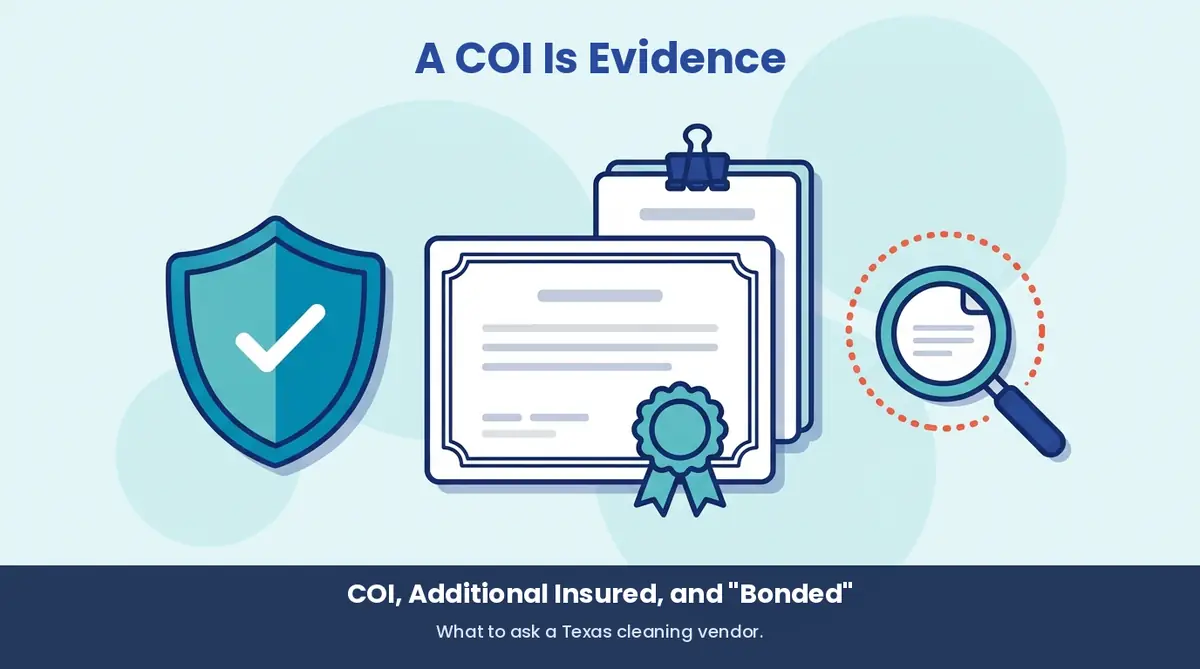
"We're fully insured and bonded." Most cleaning companies say it. A buyer who stops asking there is trusting a sentence. A buyer who asks for the paper learns a lot more in five minutes.
Direct answer: ask for a certificate of insurance (COI), then ask what it does and does not show. A COI is evidence that a policy exists. It is not the policy, it cannot add coverage the policy does not provide, and it does not by itself make you an additional insured. We are not insurance advisors. Your insurance agent should read anything you rely on.
What the Texas Department of Insurance says a certificate can and cannot do
The Texas Department of Insurance (TDI) publishes an FAQ on certificates of insurance. A few lines are useful to any buyer:
- "A certificate cannot say anything that is not the same as what is stated in the insurance policy."
- "A certificate may not use terms that would alter, amend, or extend coverage that is provided in the insurance policy."
- A certificate may not use the "Certificate Holder" box "to imply or confer any new or additional rights."
Put plainly: the certificate you receive describes the policy. If the policy does not cover something, the certificate cannot make it covered. If you need a specific protection, such as being named an additional insured, the policy has to include it. TDI's FAQ also notes that the additional insured box is meant for cases where the policy "includes an endorsement that names the certificate holder as an additional insured," and that a certificate can state that a policy contains a blanket additional insured endorsement. If your contract requires additional insured status, ask your insurance agent exactly what wording and endorsement satisfy it.
The five questions to ask
- Can you send a certificate of insurance made out to our business? If the answer is slow or vague, that is information.
- What types of coverage does it show? General liability is the baseline most buyers ask about. Ask whether the vendor carries commercial auto if vehicles are used, and workers' compensation if they have employees.
- What are the limits? Per occurrence and in the aggregate. Without the numbers, "insured" does not mean much.
- Are we an additional insured, and is it by endorsement? A request is not an endorsement. Ask for the endorsement itself if it matters to your lease or contract.
- When does the policy expire? A certificate is a snapshot. Ask how you will know when coverage renews.
What buyers actually require
Requirements vary. There is no universal Texas minimum for a cleaning vendor, and the number you need depends on your contract, your landlord, and your own insurance. The City of Cedar Park's 2026 janitorial RFP, an Austin-area public buyer, asks for $1,000,000 in general liability per occurrence and $1,000,000 in the aggregate, along with other coverage. That is one buyer's document, and your lease or insurance agent may call for something different. Treat it as an example of how specific a careful buyer gets, not as a standard.
Workers' compensation
Many people assume every Texas employer must carry workers' compensation. TDI says otherwise for most private employers: "private employers can choose to carry workers' compensation insurance coverage (subscribers), but it is not required in most cases." Employers that choose not to carry it, called non-subscribers, "must notify their employees and DWC." Texas governmental entities, TDI notes, must have it.
So a cleaning company without workers' compensation is not necessarily breaking a rule. It is a business decision, and a buyer is entitled to ask about it. Whether you require it from a vendor is a matter for your contract and your insurance agent. Some buyers do, and Cedar Park's RFP lists workers' compensation among its requirements.
What "bonded" means, and what to ask
"Bonded" is a marketing word with no single meaning, and a bond is a different product from liability insurance. If a vendor says they are bonded, ask for the bond document itself. Then ask what type of bond it is, how much it covers, who issued it, and what situation it responds to. Ask your insurance agent whether it provides the protection you are looking for. A cleaning company that can answer in specifics has done the work. One that cannot is using the word as a slogan.
Red flags
- A certificate that shows a different business name than the one you are hiring
- A policy that expired or is about to
- Language promising coverage the certificate does not show
- Reluctance to provide a certificate at all
- "Fully insured" with no number attached
What we are not claiming
We are not giving insurance advice, and nothing in this post tells you what coverage your business needs. The Cedar Park figures are one buyer's numbers. TDI's FAQ describes certificates in general; your particular policy and contract language control. If a lease or contract requires specific wording, your insurance agent should confirm it.
What to expect from us
Any vendor, including us, should be able to send a certificate, tell you which coverages are on it, and explain what an endorsement does or does not add. If your lease or contract has specific insurance requirements, send them to us at the start, before the walkthrough. If we cannot meet them, you should hear that early, in writing.
Have insurance requirements your cleaning vendor needs to meet? Request a walkthrough and send us the requirements first. To see how a written scope fits alongside insurance, start with the room-by-room scope checklist, and for the contract side, read about trapped cleaning contracts.