You hired a cleaning company, and the building looks fine. How do you know the work matches the scope? Most buyers answer with a walk-through now and then and a feeling. That works until it does not: a missed task, a leak nobody mentioned, or a disagreement about whether something was ever supposed to be cleaned.
Direct answer: a good inspection report is a short, dated record of three things: what was completed against the scope, what was not and why, and what the crew found that is not theirs to fix. Photos can support it. They cannot replace it, and they cannot prove that every task was done.
What public buyers ask for
Two 2026 public documents show what careful buyers want from a cleaning vendor on the reporting side. They are examples, not a standard.
- The Alamo Area Council of Governments' janitorial RFP says the contractor "shall provide monthly janitorial service and quality-control reporting in the format required by AACOG," and that "AACOG may conduct announced or unannounced inspections."
- The City of Cedar Park's RFP (an Austin-area buyer) requires that "at the conclusion of each service, the assigned on-site supervisor shall inspect the facility for completion and performance quality of the required services," and that damage be reported "no later than twenty-four (24) hours after discovery or occurrence."
Notice what those clauses have in common: someone checks the work, the check is recorded, and problems are reported quickly. That is the pattern worth borrowing at any size.
What a visit report should contain
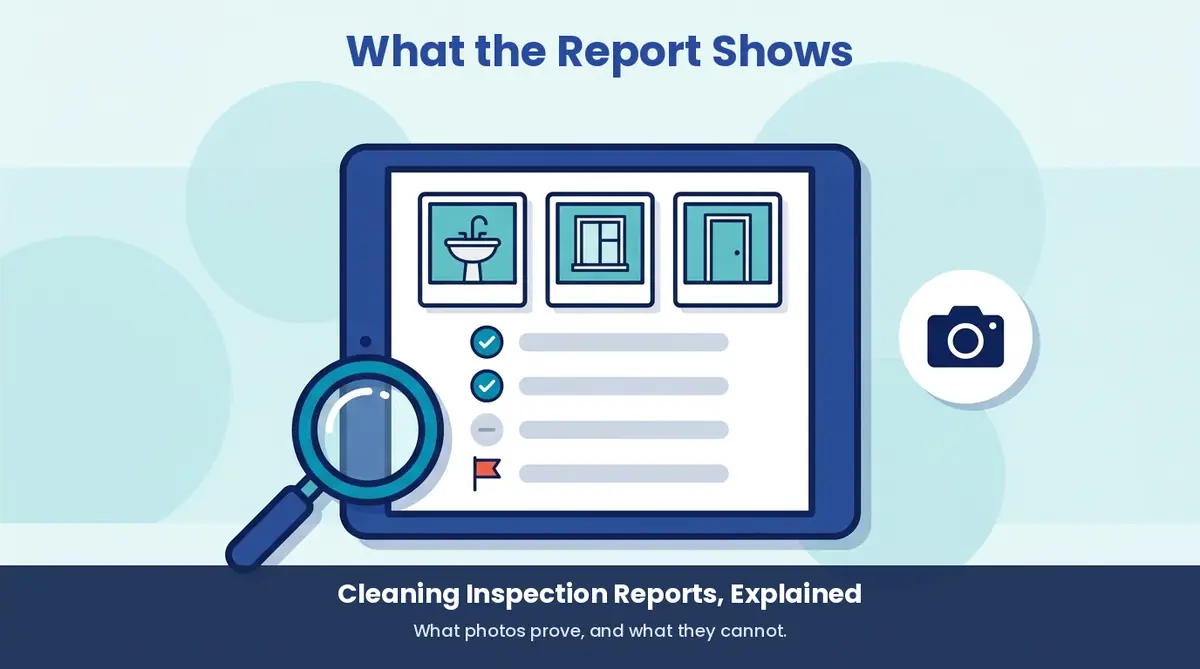
| Section | What it shows | Why it matters |
|---|---|---|
| Date, time, and crew | When the visit happened and who did it | A record you can match to access logs and invoices |
| Scope checklist | Each task in the scope marked complete, partially complete, or not done | Ties the report to the written scope, not a general impression |
| Exceptions | What was not done and why: locked room, blocked access, equipment in use | Turns "it got missed" into a documented fact |
| Findings | Leaks, damage, pest signs, burned-out lights, anything unusual | The crew sees your building at hours you do not |
| Photos | Finished areas and any finding | A visual record that supports the checklist |
| Follow-up | Who is responsible for what, and by when | A finding without an owner is just a note |
What photos prove, and what they do not
Photos help, and they have limits. Be clear about both.
What a photo can show: the condition of a surface or a room at the moment it was taken, and the presence of a specific problem, such as a stain, a leak, or a broken fixture.
What a photo cannot show:
- That every task on the list was done. A picture of a clean counter does not show the inside of the microwave.
- That the work was done well enough for a particular standard. Appearance is not the same as a measured result.
- Anything about air, hygiene, or health. A photo of a clean restroom does not prove anything about germs or illness, and we do not use photos to make that claim.
- What happened before or after the picture.
Photos are one piece of evidence. The scope checklist, the second-person check, and an occasional walk-through by you are the others.
Reports should be quick and specific
A weak report says "all areas cleaned." A useful report says "breakroom: complete; restroom 2: complete; storage room: not done, door locked; loading dock: standing water near drain, photo attached." Cedar Park's 24-hour damage clause points at the same idea: if something is wrong, tell the owner soon, in writing, with enough detail to act on.
We wrote about the same principle for rental properties in why we report problems. A leak that is caught on Monday costs less than one that is found on Friday.
What buyers actually want, and what we do not know
The two documents above ask for inspections, regular reporting, and fast notice of damage. That supports building quality control into the agreement. What it does not show is that buyers pay more for photos, or that photos change which vendor wins. We are not claiming either one.
How we run it at Chabod
We run recurring monthly facility resets for commercial and industrial clients. Each visit is photo-documented, a second person checks the work against the written scope, and anything we find outside our scope, such as a leak, damage, or a pest sign, is reported instead of ignored. The scope is the yardstick: the report answers task by task, not with a general impression. If a task could not be done, the report says so, with the reason.
Questions to ask any vendor about reporting
- Will I get a report after every visit, every month, or only when something goes wrong?
- Does the report follow my written scope, task by task?
- Who checks the work, and is it someone other than the person who did it?
- How quickly will I hear about damage or a safety issue?
- What happens to a task that could not be completed?
Want reporting that follows your scope instead of a general "all done"? Request a walkthrough and we will show you what a visit report looks like for your building. For the scope itself, start with the room-by-room checklist.