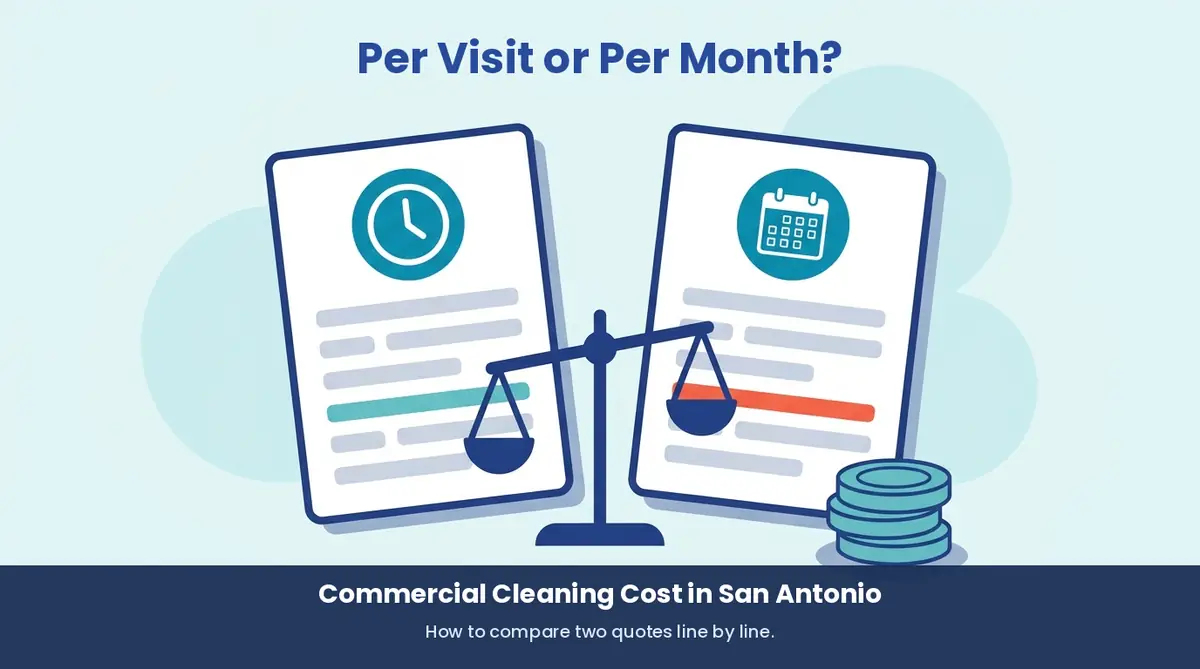
You ask three companies for a price to clean the same office. One says six cents a square foot. One says forty-five dollars an hour. One says twenty-two hundred a month. Which is cheapest?
Nobody can tell from those numbers, because they measure three different things. That is the real answer to "how much does commercial cleaning cost in San Antonio": it depends on the building, the scope, and the frequency, and any number that does not say per what, for what, and how often is not a price yet.
Direct answer: we are not going to give you a San Antonio average, because we have not found a verified one and we are not going to invent one. What we can give you is a way to turn any quote into numbers you can compare.
The four ways commercial cleaning gets priced
| Pricing model | What you see | What it shows | What it hides |
|---|---|---|---|
| Per square foot | A rate times your area | Easy to scale across buildings | Which square feet, how often, and what tasks |
| Per cleaner-hour | An hourly rate | Labor cost is explicit | How many hours the building really needs |
| Flat monthly | One number per month | Predictable budget | Visits per week, tasks included, and what happens in short months |
| Per visit or per project | A price per service | Clear for one-time or periodic work | Total annual cost if visits repeat |
None of these is dishonest. Each one just puts a different piece of the picture up front.
A crew-hour is not a cleaner-hour
Hourly quotes catch people on this one. Two cleaners working three hours is six labor-hours, and most companies bill labor-hours. If one quote says "$45 an hour" and you assume that means one person for one hour, you will compare it wrongly against a flat price that was built on a full crew. Ask: how many people, for how many hours, per visit?
Converting three quotes into the same unit
Here is a worked example with made-up numbers, to show the method. Assume a 5,000 square foot office cleaned twice a week, 104 visits a year.
| Quote A | Quote B | Quote C | |
|---|---|---|---|
| How it is stated | $0.06 per sq ft, per visit | $45 per cleaner-hour | $2,200 per month flat |
| Math per visit | 5,000 × $0.06 = $300 | 2 cleaners × 3 hours × $45 = $270 | $26,400 ÷ 104 = about $253.85 |
| Per year | $31,200 | $28,080 | $26,400 |
| Per month, averaged | $2,600 | $2,340 | $2,200 |
These numbers are illustrations, not San Antonio prices. The method is what matters: convert every quote into cost per visit and cost per year, then ask whether the scope behind each number is the same. Quote C looks cheapest here, but if it covers three hours of work for one cleaner and Quote B covers six labor-hours, you are not comparing equal service. The cheapest number is only the cheapest if the work behind it matches.
Published rate cards are advertising
If you search for rates online, you will find rate cards from local cleaning companies. Treat them as marketing, written for a typical building, not yours. They are useful for understanding which pricing model a company prefers. They are not market averages, they are not quotes, and a careful company will tell you a walkthrough is needed to confirm anything.
Sales tax is part of the price
Texas treats most cleaning of commercial buildings as taxable. The Texas Comptroller's publication on taxable services says that if you operate "a maid, janitorial, custodial, or swimming pool maintenance service," you should collect sales tax, and that tax applies to the charge to clean "a home, office, warehouse, garage, restaurant, or any other building." State tax is collected "plus any local (city, county, special purpose district, or transit) taxes" on the amount billed.
What that means when you compare quotes: ask whether the number is before or after tax, and ask for tax as a separate line. Two quotes that look $200 apart may be identical once tax is added to one and not the other. Questions about exemptions or your own situation belong with your CPA or the Comptroller, not with a cleaning blog.
Comparing two quotes line by line
Put the quotes side by side and check each of these:
- Scope. Are the rooms and tasks written out, or is it "general cleaning"? (Our scope-of-work checklist shows what a written grid looks like.)
- Frequency. How many visits a week, and which tasks happen on which visit?
- Labor. How many people and how many hours per visit?
- Supplies. Who buys chemicals, liners, and paper goods?
- Periodic work. Are carpet extraction, floor machine work, and glass priced in or priced separately?
- Quality control. Who checks the work, and what happens if something is missed?
- Insurance. What coverage does the vendor carry, and can they send a certificate?
- Price changes. When can the price go up, by how much, and with how much notice?
- Exit. How do you end the agreement if it is not working?
What a proposal should contain
A real proposal is more than a price. It should name both legal parties and the property address, list the assumptions the price rests on, include the schedule, explain staffing and what happens when someone is out, list exclusions, state the price and how tax is handled, say who supplies consumables, describe how the work gets started, explain how quality is checked and how problems get fixed, list insurance, and spell out how either side can end the agreement. If a proposal arrives as a single number in an email, ask for the rest.
What we are not claiming
We are not stating a San Antonio median, a typical per-square-foot rate, or a premium for any type of facility, because we have no audited data on closed contracts and will not guess. The example above uses invented figures to show arithmetic. Nothing here is tax advice.
How we quote at Chabod
We quote the property, not a generic rate. That starts with a walkthrough, then a written scope and a price that is tied to it. We run recurring monthly facility resets for commercial and industrial clients, and the quote for each one lists what is included and how often, so the number on the page corresponds to work you can check. We do not post a rate card, because a rate card would put the number before the building.
Comparing quotes right now? Send us the scope you were given and we will walk the building and write ours the same way, so you can lay them next to each other on equal terms.