A facility manager tells a vendor, "We need a deep clean." The vendor sends a quote for a one-time scrub of the whole building. Three weeks later the floors are spotless, the trash is overflowing, and the manager wonders why they paid for something that did not last.
The problem was not the vendor. "Deep clean" and "janitorial" are two different purchases, and the words get used for both.
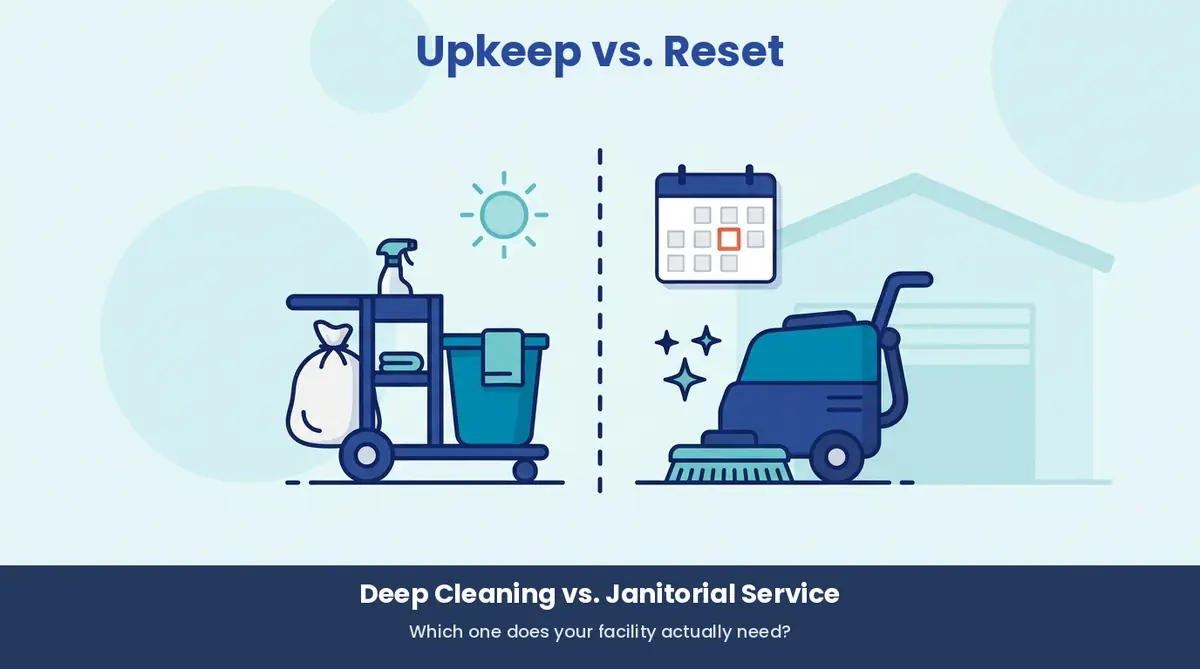
Direct answer: janitorial service is upkeep. It keeps a building at a baseline day after day: trash, restrooms, touch points, floors. A deep-clean reset is a defined set of intensive tasks done on a calendar, usually monthly or quarterly, that upkeep does not reach. A monthly reset does not replace daily upkeep, and daily upkeep does not replace a reset. Many buildings need both, from the same company or from two.
Two purchases, side by side
| Janitorial service (upkeep) | Deep-clean reset | |
|---|---|---|
| Purpose | Keep the building at a steady baseline | Reach what daily work does not |
| Rhythm | Daily to weekly | Monthly, quarterly, or one-time |
| Typical tasks | Trash, restroom restock and cleaning, floor care, touch surfaces | Detail work, floor machine work, equipment exteriors, buildup removal, areas that are too slow for a nightly crew |
| How it is billed | Often a monthly or per-visit amount | Often per reset, or a flat amount per month |
| What happens in between | It is the in-between | Someone else covers it |
Public buyers separate these as well. The Alamo Area Council of Governments' 2026 janitorial RFP splits its work into daily, weekly, and periodic services, and keeps day porter coverage as its own line. That is one document from one agency, not an industry standard. It is a good illustration of how a careful buyer separates routine from periodic.
"Deep clean" is not a scope
The words tell you nothing without a task list. One company's deep clean is another company's regular visit with a higher price. Define a reset by the tasks it includes, how often they happen, and what the finished result looks like. If you have not seen the list, you have not seen the scope. Our scope-of-work checklist shows what the list should look like, and our cost guide covers how to compare prices once you have one.
A reset scope for an industrial or light-manufacturing space might include items like these (for illustration only):
- Break rooms and restrooms, detailed beyond routine visits
- Entrances, offices, and common areas, including baseboards and corners
- Floor care in non-production areas
- Wipe-down of cabinet, locker, and equipment exteriors that are safe to touch
- Trash, debris, and buildup removal from corners and edges that routine visits skip
What a reset is not: it is not a substitute for someone emptying the trash on Tuesday.
Who covers the days in between
This is the question most buyers skip. If you hire a monthly reset, who handles restroom restocking, spills, trash, and the breakroom between visits? Your answer is one of three:
- Your own team. Common in smaller facilities. It works as long as someone owns it.
- A separate janitorial vendor. The reset company deals with the periodic work, the janitorial company with the daily work.
- A day porter. A person on site during business hours to keep restrooms and common areas current.
Write the answer into the agreement. A monthly reset that arrives into a building nobody has maintained for three weeks is a different job than one that arrives into a building that is kept up.
When each one makes sense
A reset tends to fit when:
- The facility has a team that keeps up routine tidiness, but the buildup in corners, breakrooms, and shared areas gets ahead of them
- It is an industrial, warehouse, or shop environment where nightly janitorial would not make sense
- Another company already handles janitorial and you want periodic detail work added
- You are resetting a space after a project, a move, or a busy season
Daily janitorial tends to fit when:
- The building has regular foot traffic and public-facing restrooms
- Customers or visitors see the space every day
- There is no internal team to cover the baseline
Most mid-size facilities end up with both. The point is to know which you are buying.
What we do, and what we do not
We run recurring monthly deep-clean resets for commercial and industrial clients, and have for about two years. The work follows the same pattern every time: a property-specific SOP, a written scope, photo documentation of the finished areas, a second person checking the work against the scope, and a written note when we find something that is not ours to fix, such as a leak, damage, or a pest sign. We wrote about why a facility reset is part of looking after employees separately. This post is about the practical question of what to buy.
Reset scopes are about cleaning. Machine repair, hazardous-residue removal, and floor refinishing are separate trades with their own qualifications. If a facility needs one of them, we say so in writing instead of quoting around it. We are also not a replacement for daily janitorial service, and we will tell you if that is what your building needs.
What we are not claiming
We are not claiming that a reset improves health, morale, or productivity, and we are not holding up any certification as a qualification. A reset is a defined cleaning service done on a schedule. What it does for your business depends on your building and how you use it. The AACOG document is an example of how one agency organizes its scope. It does not prove what private businesses typically buy.
Questions to ask any vendor about a reset
- What exact tasks are in a reset, and can I see them in writing?
- How often, and on what schedule?
- Who is on site, and who checks the work afterward?
- What do you do if you find damage, a leak, or something unsafe?
- What is excluded, and who handles it?
- Who covers the building between resets?
Not sure whether your facility needs upkeep, a reset, or both? Request a walkthrough and we will tell you plainly which one fits, even if the answer is that you need a janitorial vendor and not us.